When 18-year-old Joe Keller vanished from a dude ranch in Colorado's Rio Grande National Forest, he joined the ranks of those missing on public land. No official tally exists, but their numbers are growing. And when an initial search turns up nothing, who'll keep looking?
Tuesday, March 28, 2017
*** This is an interesting story about 1,600 people going missing in our national parks.

Thursday, March 23, 2017
Good news on hardboiled crime
I’ve always dabbled in reading old, pulp noir detective books, but dove head-first into them the past couple years. What started as an obsession with Donald Westlake turned me toward Lawrence Block and now I’m into Robert B. Parker, Max Collins, John MacDonald and others. So much so that I spent the past year writing my own hardboiled detective novel, or three.
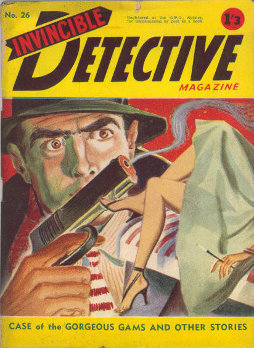 So it’s with glee that I report this story that I may be on the right side of the publishing trend for a change as the ol’ fedora and fists novels make a comeback.
As political corruption, violence and gender politics gain fresh relevance, pulp noir is attracting new voices and audiences, giving the gumshoe a 21st-century reboot
As political corruption, violence and gender politics gain fresh relevance, pulp noir is attracting new voices and audiences, giving the gumshoe a 21st-century reboot
“Corruption and violence are hardly things of the past. Men in power taking advantage of the weak and getting away with murder – that’s the stuff of headlines today,” he says. “People turning to crime in desperation or out of frustration and anger. Frightened men on the run, or vengeful ones on the hunt – when did that ever go out of date?”Check it out (even quote Mr. Block): Dames, detectives and dope: why we still love hardboiled crime
Monday, March 20, 2017


Thursday, March 9, 2017
If you read one news story this month, make it this one
This is a startling, in-depth article on drug abuse. The numbers are staggering.
Fifty-two thousand Americans died of overdoses in 2015—about four times as many as died from gun homicides and half again as many as died in car accidents.I also found the politically-correct nonsense espoused by some of the mental health providers to be maddening. The last place we need to be dumbing down the language, so as not to offend, is when it has life-and-death consequences.
It is true that we cannot arrest our way out of a drug problem. But we cannot medicate and counsel our way out of it, either, and that is what we have been trying to do for almost a decade.The story is long but packed with information. I didn't find any partisan edge to it either. Well worth your time. You'll be a smarter person for reading it.
The population of addicts is like the population of deer. It is highest in rustic places with access to urban supplies. Missouri’s heroin problem is worst in the rural counties near St. Louis.
Monday, March 6, 2017
University prez responds to bigots: A Tapestry of Talent
Some racist flyers were recently put up in the dark of the night by a KKK idiot at three colleges in South Dakota, including the S.D. School of Mines & Technology.
SDSMT President Heather Wilson (and nominee to be next Secretary of Air Force) responded with the following letter to students and staff. It's about as good of response as could be done with the exception of punching the perpetrator(s) in the face.
"No Irish Need Apply"
That was the sign in many New England shop windows that faced my great grandmother, Annie Skalley, when she came to America from County Cork in the late 1800s.
Some time ago, my cousin Carol found one of those signs in a flea market and had it framed. It hung in her kitchen as an ironic reminder of how far our family had come in three short generations.
Carol's father, the son of Italian immigrants, had enlisted in the U.S. Army and had been a medic in the Battle of the Bulge. A member of the greatest generation, he came home after the war to open a drug store that served our small town for decades. When he married my Aunt Anne, named after Annie Skalley, it was quite controversial for an Irish girl to marry an Italian boy. He endured his share of insults, which I won't share here.
With every wave of immigration in America, some have promoted the fiction that the only ones who belong here, the only ones who really contribute to this remarkable country, the only "real" Americans, are people who look and sound and speak and pray like the person we see when we look in the bathroom mirror in the morning.
But when we set aside our fears and our pride, and look around us, we know that's just not true.
Here, at the School of Mines, we prepare leaders in engineering and science and we advance the world’s knowledge. Some of these young leaders gather in the Newman Center on Sunday nights; others pray five times a day facing Mecca. Our exceptional students are the descendants of slaves and the descendants of Norwegian farmers. Some are indigenous here, others arrived as refugees from wars that still rage. They are the children of wealthy parents who have been provided every opportunity, and the children of unknown fathers who have aged out of foster care. As faculty and staff we have similar winding paths that brought us to this place.
All of us are part of the rich tapestry of talent that will help solve the great challenges of the twenty-first century. Each of us deserves to be treated with dignity and respect.
Many of you are aware that over the past week someone has been placing posters around campus that remind me of the signs Annie Skalley saw as a girl. The same posters have shown up on at least two other college campuses in South Dakota. A lot of you may not have seen them at all, and are wondering why I’m writing this email to you. I’m writing because some of you have seen them, and have been deeply offended by them. When posters from outside groups appear on our campus, they are taken down, as is our standard policy.
The appropriate response to an objectionable idea is a better idea articulately conveyed. It is to reach out to our friends and colleagues and students and let them know – very explicitly – that we are glad they are here. It is to share our stories, share a meal, share a smile, share a word of welcome. We work together to solve hard problems and discover new things. We do so joyfully with friends who have different stories from our own.
One of our very successful alumni is Peter Stephans. Peter escaped from Hungary in 1956 and came to South Dakota, barely able to speak English. I met him shortly after I became the President of Mines at the company he now owns outside Cleveland. We drove in his sports car to have lunch at his country club. When the lovely meal was finished, I asked this very successful CEO what he remembered about the School of Mines, and his eyes filled with tears. "They welcomed me," he said. "I had nothing. I was just a boy, a refugee very far from home. And they welcomed me."
That is who we are. And no poster hung in the dark of night will change the fundamental decency of who we choose to be.
Have a pleasant and restful spring break. Please take some time with each other in the coming days, and with our students when they come back, for conversation and fellowship, each in your own way. That will make all the difference.
Warm Regards,
Heather Ann Wilson
President
SDSMT President Heather Wilson (and nominee to be next Secretary of Air Force) responded with the following letter to students and staff. It's about as good of response as could be done with the exception of punching the perpetrator(s) in the face.
***
That was the sign in many New England shop windows that faced my great grandmother, Annie Skalley, when she came to America from County Cork in the late 1800s.
Some time ago, my cousin Carol found one of those signs in a flea market and had it framed. It hung in her kitchen as an ironic reminder of how far our family had come in three short generations.
Carol's father, the son of Italian immigrants, had enlisted in the U.S. Army and had been a medic in the Battle of the Bulge. A member of the greatest generation, he came home after the war to open a drug store that served our small town for decades. When he married my Aunt Anne, named after Annie Skalley, it was quite controversial for an Irish girl to marry an Italian boy. He endured his share of insults, which I won't share here.
With every wave of immigration in America, some have promoted the fiction that the only ones who belong here, the only ones who really contribute to this remarkable country, the only "real" Americans, are people who look and sound and speak and pray like the person we see when we look in the bathroom mirror in the morning.
But when we set aside our fears and our pride, and look around us, we know that's just not true.
Here, at the School of Mines, we prepare leaders in engineering and science and we advance the world’s knowledge. Some of these young leaders gather in the Newman Center on Sunday nights; others pray five times a day facing Mecca. Our exceptional students are the descendants of slaves and the descendants of Norwegian farmers. Some are indigenous here, others arrived as refugees from wars that still rage. They are the children of wealthy parents who have been provided every opportunity, and the children of unknown fathers who have aged out of foster care. As faculty and staff we have similar winding paths that brought us to this place.
All of us are part of the rich tapestry of talent that will help solve the great challenges of the twenty-first century. Each of us deserves to be treated with dignity and respect.
Many of you are aware that over the past week someone has been placing posters around campus that remind me of the signs Annie Skalley saw as a girl. The same posters have shown up on at least two other college campuses in South Dakota. A lot of you may not have seen them at all, and are wondering why I’m writing this email to you. I’m writing because some of you have seen them, and have been deeply offended by them. When posters from outside groups appear on our campus, they are taken down, as is our standard policy.
The appropriate response to an objectionable idea is a better idea articulately conveyed. It is to reach out to our friends and colleagues and students and let them know – very explicitly – that we are glad they are here. It is to share our stories, share a meal, share a smile, share a word of welcome. We work together to solve hard problems and discover new things. We do so joyfully with friends who have different stories from our own.
One of our very successful alumni is Peter Stephans. Peter escaped from Hungary in 1956 and came to South Dakota, barely able to speak English. I met him shortly after I became the President of Mines at the company he now owns outside Cleveland. We drove in his sports car to have lunch at his country club. When the lovely meal was finished, I asked this very successful CEO what he remembered about the School of Mines, and his eyes filled with tears. "They welcomed me," he said. "I had nothing. I was just a boy, a refugee very far from home. And they welcomed me."
That is who we are. And no poster hung in the dark of night will change the fundamental decency of who we choose to be.
Have a pleasant and restful spring break. Please take some time with each other in the coming days, and with our students when they come back, for conversation and fellowship, each in your own way. That will make all the difference.
Warm Regards,
Heather Ann Wilson
President
Monday, February 27, 2017
A no-drama link-oh-rama
So I've been working on some detective writing this past year or so, more along the lines of hard-boiled, noir, like I've been binge reading. Hope to wow you with the first installment in a couple months, probably, maybe, who knows. Until then, here's some detecting to kick off the link-oh-rama:
*** Book review: Investigating literature’s most epic detective (for now).
*** Basically, this tells me, if you want to be like President Trump, Kanye West or Tomi Lahren (how the heck does she get thrown in with those names?) then don't read books.
Several “successful people” eschew books, including President Trump ( “I read passages, I read areas, chapters”), Kanye West ( “I am a proud non-reader of books”) and The Blaze personality Tomi Lahren (“I don’t like to read long books. I like to read news”).
Even if that list isn’t very convincing, people whom I personally am assured are much smarter than myself, such as my husband (who reads case law for a living and in-depth statistical analysis for fun) probably would answer “No” if the Pew Foundation came around asking if he had read a book in the past year.
So sure, I’m not going to be wringing my hands over Americans’ lack of reading anytime soon, aside from general lament toward the cult of anti-intellectualism currently present in some circles. But as an avid reader myself—a proud purveyor of biographies, classic literature, and utter trash alike (I really, really, love “Confessions of a Shopaholic” and mass-market Star Trek books) — I am an advocate of cracking open a book, firing up your e-reader, or investing in an Audible.com account. Here’s why.*** Pretty tempted to get this one: Huck Out West. An excerpt in Huck-speak:
But no, just when I’m fixing to set back and catch up on my fishing on the Mississippi, here comes Huck Out West by Mr. Robert Coover. He’s writ novels that was interesting but tough, like The Origin of the Brunists, about how religion gets mangled by the folks who believe in it. And The Public Burning, about a real couple called Ethel and Julius Rosenberg that got convicted as spies. Railroaded is the way he seed it. They wound up in the electric chair. This Mr. Coover is one angry man.
Well, here, he’s the ventriloquist and I’m the innocent wanderer again, heading for the mountains like Mr. Twain once did, stumbling into the dark side of the Western Expansion. Some of the old Missouri gang are with me. Trouble is, Mr. Coover, he makes them into folks I don’t hardly recognize. For instance, Jim could break your heart when he talked about how much he loved his wife and children that was sold into slavery.*** Prison made him believe in literature. I feel ya dude.
Naji is best known internationally for being imprisoned for the sexual content and drug references in his novel The Use of Life, in a society where these subjects remain largely taboo.
However, sitting in his apartment close to the Nile in central Cairo, Naji plays down the image he has acquired as a result of his plight, and the themes that got him into trouble.
A blend of existentialist literature, fantasy and social criticism, The Use of Life follows Bassam, a young man who lives in an alternate Cairo, which Naji imagines as a grubby metropolis that has risen from a series of natural disasters that levelled the city. Filled with irreverent references to masturbation, fetishes and pornography, the book is consistently transgressive. Bassam’s opinions and ideas are also knowingly progressive – having sex with an older woman, keeping transgender friends, indulging in drugs and drink.
“Sex and drugs play a very important part in Cairo,” says Naji – while stressing that they are not the main themes of his novel. As he sees it, The Use of Life is about “the history of the city and how it has been designed … and how people in this Kafkaesque maze are trying to find a small piece of joy”.
Thursday, February 23, 2017
Chaput has a new book out. Read it.
Archbishop Charles Chaput, former bishop in Rapid City, has a new book out, Strangers in a Strange Land. From the excerpts I’ve read it looks to be the usual interesting writing I’ve grown accustomed to from him.
 Chaput has a unique ability to bring religious writing down to the level of the average Joe. It’s not like reading a doctoral thesis. His book, Render Unto Caesar: Serving the Nation by Living Our Catholic Beliefs in Political Life, is one of my favorite books of any genre.
For instance, from Strangers:
In fact, this might be a good Lenten read for me. Reminder, Lent starts on March 1, Ash Wednesday. Be there or be heathen.
For instance, from Strangers:
But what we do in the world, how we live and how we love (or misuse love) — these things always have consequences. And they always emerge from the past to pay a visit. Choices don’t stay buried.That echoes my wife’s most oft-repeated words to our kids and to the college Catholic kids she serves at the SD School of Mines Newman Center: "Make good choices." For the most part they have, but not always. Kind of like her husband.
In fact, this might be a good Lenten read for me. Reminder, Lent starts on March 1, Ash Wednesday. Be there or be heathen.
Wednesday, February 22, 2017
Finished: Block's 'A Diet of Treacle'
I knocked off another short novel by Lawrence Block over the weekend. Oddly enough, I even had to look up one of the words in the title: A Diet of Treacle.
 Never heard of treacle before. Apparently it’s a British molasses type mixture. My old-school dictionary didn’t even have an entry for it, so I had to Google it.
British. molasses, especially that which is drained from the vats used in sugar refining.
The title is actually better than its original title in 1961: Pads Are for Passion.
My favorite thing about the book is that it’s not all tied together until the last sentence. I love that. The book is dark. Really dark, even by my standards. Unlike most murder mysteries, he doesn’t actually get to the murder until you’re two-thirds through the book. Usually they say you have to have the murder in the first 100 pages. But, Block being Block, makes it work.
Very interesting work. Well worth the read. I gave it a 7- on the 10-point Haugenometer.
British. molasses, especially that which is drained from the vats used in sugar refining.
Also called golden syrup. A mild mixture of molasses, corn syrup, etc., used in cooking or as a table syrup.The title didn’t really make any sense until I finished the book and thought about it. The book begins with a quote from Alice in Wonderland that helps make it more understandable.
The title is actually better than its original title in 1961: Pads Are for Passion.
Anita Carbone was a good girl—and it bored her.
That’s why she took the long subway ride down to Greenwich Village, home of the Beats and the stoners, home to every kind of misfit and dropout and free spirit you could imagine. It was where she met Joe Milani, the troubled young war veteran with the gentle touch. But it was also where she met his drug-dealing roommate—a man whose unnatural appetites led to murder ...Reviewers call this a beatsploitation novel because he seems to be knocking the beatniks/hipsters of the 1960s in Greenwich Village and their sex and drugs lifestyle.
My favorite thing about the book is that it’s not all tied together until the last sentence. I love that. The book is dark. Really dark, even by my standards. Unlike most murder mysteries, he doesn’t actually get to the murder until you’re two-thirds through the book. Usually they say you have to have the murder in the first 100 pages. But, Block being Block, makes it work.
Very interesting work. Well worth the read. I gave it a 7- on the 10-point Haugenometer.
Monday, February 13, 2017
Coming full circle with the milkweeds
Getting some stuff started in my greenhouse recently reminded me of how I’ve come full circle in life from playing in the dirt as a kid. It wasn’t the dirt so much as it was the plant – milkweed.
One of the things today’s youth can barely fathom was the summer ritual I endured with several other friends and neighbors. It was called walking beans. Starting at 6 or 7 in the morning, and sometimes in the evenings, we’d walk with corn knives or hoes (another term I’d have to explain to today’s kids) and would chop the weeds out of the soybeans. The primary weeds were milkweeds, cocklebur and volunteer corn.

It was a thankless, monotonous job that was only made tolerable by the friends you did it with. And it was an equal opportunity job, as the farm girls joined in. They key was to try and get lined up next to the prettiest one, as if really mattered if I was lined up closest to or farthest away from her, but still. It made it easier when we threw dirt clods at each other. The best prank to pull though was the old “how’d you miss that weed, you idiot?” ploy. For that one you lagged behind for a bit and then when the person a few rows over got far enough ahead you’d grab a big weed you’d chopped and go push it into the ground in their rows. Then after they got far ahead and you caught up, you’d casually turn around, scan the field and say: “How’d you miss that weed, you idiot?” They’d be pretty sure they didn’t but couldn’t risk not retracing their steps to make sure.
Bean walking resulted in one surgery for me, when one of my friend’s hoes severed a ligament in my hand. And I’m not sure what, but am pretty sure there may be some effects to come from the Raid that Selma Hansen sprayed on me when we walked for her and Selmer (yes, Selmer and Selma Hansen) in the evenings during the height of mosquito spawn. She claimed Off wasn’t strong enough for them. And who was this punk kid to argue with her? Douse me good, Selma!
I caught the tail end of the “bean buggy” fad, where lazy kids got to actually sit in a seat and spray the weeds. That didn’t last long though as evil corporation Monsato came along and ruined the bean walking biz by developing Round-up Ready beans. Now farmers can just whiz through the field and spray the whole works and the beans will survive.
Some will say that this has contributed to the decline of bees and monarch butterflies. I don’t know. I’m just an English major. But it probably didn’t help.
So where the “full circle” thing comes into play now is that this year for the first time I found myself planting milkweeds. Yes, once the bane of my existence, now I’m trying to grow the #&*^#$ things.
Why?
Because monarch butterflies need them to raise baby butterflies, and what can I say: I like baby butterflies. Unlike human babies, they are quiet, let you sleep and don’t make messes.
One thing I’ve noticed about my spot of heaven in the Hills is that it’s really difficult to find milkweeds and monarchs. I’m sure there’s some rancher out here who can point me otherwise but they aren’t around like they used to be and the milkweeds certainly aren’t nearly as abundant as Canadian thistle.
So last fall I spotted a milk weed, can’t even remember where, and went over and picked a peck of pods. I saved them and tried starting some a few weeks ago. Of the 12x12 container, I only had one seed germinate. I think it was a storage issue for me and I didn’t do a very good job. I’ll keep trying.
The plan, so my neighbors won’t hate me more than they already do, is to pick the pods this fall in my garden before they burst open and all the seeds start flying away. And the air will waft with clouds of butterflies and rainbows will fill the sky. That’s the plan anyway. But as I always advise people, Custer had a plan too.
One of the things today’s youth can barely fathom was the summer ritual I endured with several other friends and neighbors. It was called walking beans. Starting at 6 or 7 in the morning, and sometimes in the evenings, we’d walk with corn knives or hoes (another term I’d have to explain to today’s kids) and would chop the weeds out of the soybeans. The primary weeds were milkweeds, cocklebur and volunteer corn.
It was a thankless, monotonous job that was only made tolerable by the friends you did it with. And it was an equal opportunity job, as the farm girls joined in. They key was to try and get lined up next to the prettiest one, as if really mattered if I was lined up closest to or farthest away from her, but still. It made it easier when we threw dirt clods at each other. The best prank to pull though was the old “how’d you miss that weed, you idiot?” ploy. For that one you lagged behind for a bit and then when the person a few rows over got far enough ahead you’d grab a big weed you’d chopped and go push it into the ground in their rows. Then after they got far ahead and you caught up, you’d casually turn around, scan the field and say: “How’d you miss that weed, you idiot?” They’d be pretty sure they didn’t but couldn’t risk not retracing their steps to make sure.
Bean walking resulted in one surgery for me, when one of my friend’s hoes severed a ligament in my hand. And I’m not sure what, but am pretty sure there may be some effects to come from the Raid that Selma Hansen sprayed on me when we walked for her and Selmer (yes, Selmer and Selma Hansen) in the evenings during the height of mosquito spawn. She claimed Off wasn’t strong enough for them. And who was this punk kid to argue with her? Douse me good, Selma!
I caught the tail end of the “bean buggy” fad, where lazy kids got to actually sit in a seat and spray the weeds. That didn’t last long though as evil corporation Monsato came along and ruined the bean walking biz by developing Round-up Ready beans. Now farmers can just whiz through the field and spray the whole works and the beans will survive.
Some will say that this has contributed to the decline of bees and monarch butterflies. I don’t know. I’m just an English major. But it probably didn’t help.
So where the “full circle” thing comes into play now is that this year for the first time I found myself planting milkweeds. Yes, once the bane of my existence, now I’m trying to grow the #&*^#$ things.
Why?
Because monarch butterflies need them to raise baby butterflies, and what can I say: I like baby butterflies. Unlike human babies, they are quiet, let you sleep and don’t make messes.
One thing I’ve noticed about my spot of heaven in the Hills is that it’s really difficult to find milkweeds and monarchs. I’m sure there’s some rancher out here who can point me otherwise but they aren’t around like they used to be and the milkweeds certainly aren’t nearly as abundant as Canadian thistle.
So last fall I spotted a milk weed, can’t even remember where, and went over and picked a peck of pods. I saved them and tried starting some a few weeks ago. Of the 12x12 container, I only had one seed germinate. I think it was a storage issue for me and I didn’t do a very good job. I’ll keep trying.
The plan, so my neighbors won’t hate me more than they already do, is to pick the pods this fall in my garden before they burst open and all the seeds start flying away. And the air will waft with clouds of butterflies and rainbows will fill the sky. That’s the plan anyway. But as I always advise people, Custer had a plan too.
Thursday, February 9, 2017
Time to get smashed
I’m not an e-book guy. I’ve read one book, maybe parts of two others on my Kindle. But I recognize I’m in the minority on this, kind of like my presidential vote for Darrell Castle. I’m a 1-percenter. I get it.
Many people love their e-readers, and I’m happy for you. So happy for you that I would again like you to take a look at a really cool e-book site called smashwords.com. I got on the site years ago in its inception as a book seller. I have my novels there and some short stories.
There are several great points for you to consider as a reader.
Firstly, the variety. There’s a category for everybody: fiction, non-fiction, essays, poetry, plays. You want travel? Got it. Religion? Yep. Gardening? Uh, huh. Some sexier stuff? Oh, yeah.
Now you aren’t going to find Dean Koontz or JK Rowling hanging out at smashwords. But you might find the NEXT Koontz or Rowling there.
I won’t lie to you, there’s some total crap writers there. But the majority are very good writers. And the downloads are much cheaper than you’ll find at Amazon. And it’s free and simple to sign up. Plus you get free samples of almost everything you might want before you buy.
Secondly, you can download in whatever format you want. Got a Kindle, a Nook, a Cranny, a Pad, whatever.
Smashwords says: The Smashwords Store provides an opportunity to discover new voices in all categories and genres of the written word. Once you register, the site offers useful tools for search, discovery and personal library management. Most of our books are affordably priced and multi-format. Over 55,000 of our books are priced at free.
As a book seller there, I’ve found it to be better than Amazon.
It seems the customers at Smashwords are very loyal to the authors there. I’ve sold hundreds of e-books and thousands of free downloads. The freebies are everything from short stories (to hopefully encourage people to buy this dude’s novels) to other give-aways and specials I’ve had on those books.
That’s the other cool thing they do is set up coupons and deals at whatever discount I want for however long I want. Amazon is much more heavy-handed. They have rules for everything and are very territorial. I get it. Fine.
But I’ve sold books in both places, and Smashwords has smashed Amazon when it comes to digital sales for me.
Smashwords lets me set my price and I get a much bigger percentage of that than Amazon too. It's not even close.
Perhaps my favorite thing about Smashwords though is that once I upload my novel (an easy process) and my cover and my particulars (cost, etc.), then within days, sometimes hours, they then ship it to other outlets like Barnes and Noble, Apple, libraries and everywhere (except Amazon).
This isn’t to bash Amazon. That’s where I buy majority of my pulp fiction. But Amazon controls 70 percent of the market. If you want to help the little guys, get signed up at Smashwords and throw a couple bucks to an independent author. He or she might be famous someday and you can take partial credit.
And you'll be all signed up and ready to go should my next novel pop up there this spring. That's the rumor anyway.
Monday, February 6, 2017
Finished: In Sunlight or In Shadow
Legendary author Lawrence Block corralled some of his author buddies and came up with an ingenious idea. Each author picked an Edward Hopper painting (you know ‘em when you see ‘em) and the writer was tasked with using that painting as inspiration for a short story.
The book is called: In Sunlight or In Shadow: Stories Inspired by the Paintings of Edward Hopper.
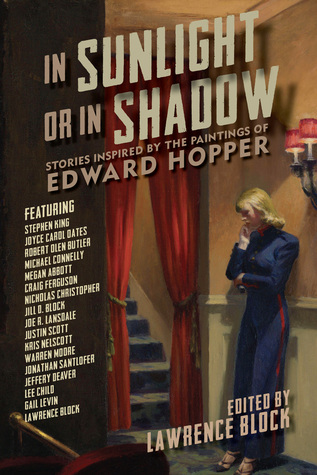 I started this in December and have been reading them off and on. I love these kind of anthologies where you can knock one off when you have fifteen minutes. I just finished it this weekend and absolutely loved it. If I counted this as a 2016 read, it would be my favorite of the year.
From Amazon:
It introduced me to some accomplished authors I’d never read before and I quickly added some of their works to my Amazon cart and my BTB (books to buy) list I take to the used book store.
I was really looking forward to the Lee Child story (he of Jack Reacher), but it was surprisingly one of the weaker ones of the bunch. Seemed like he just threw something together quick and didn’t even use Jack Reacher in the story. I thought he dropped the ball on that.
Stephen King’s was expectedly creepy. I saw his was nominated with Block’s short story for a prestigious Edgar Award (named after Poe).
Goodreads lists some of the authors:
It hits 7+ out of 10 on the Haugenometer. Fantastic. Below is probably the most famous Hopper painting: Nighthawks:

The book is called: In Sunlight or In Shadow: Stories Inspired by the Paintings of Edward Hopper.
From Amazon:
A truly unprecedented literary achievement by author and editor Lawrence Block, a newly-commissioned anthology of seventeen superbly-crafted stories inspired by the paintings of Edward Hopper.Amazonians give it 4.5 out of 5.
It introduced me to some accomplished authors I’d never read before and I quickly added some of their works to my Amazon cart and my BTB (books to buy) list I take to the used book store.
I was really looking forward to the Lee Child story (he of Jack Reacher), but it was surprisingly one of the weaker ones of the bunch. Seemed like he just threw something together quick and didn’t even use Jack Reacher in the story. I thought he dropped the ball on that.
Stephen King’s was expectedly creepy. I saw his was nominated with Block’s short story for a prestigious Edgar Award (named after Poe).
Goodreads lists some of the authors:
Contributors include Stephen King, Joyce Carol Oates, Robert Olen Butler, Michael Connelly, Megan Abbott, Craig Ferguson, Nicholas Christopher, Jill D. Block, Joe R. Lansdale, Justin Scott, Kristine Kathryn Rusch, Warren Moore, Jonathan Santlofer, Jeffery Deaver, Lee Child, and Lawrence Block himself. Even Gail Levin, Hopper’s biographer and compiler of his catalogue raisonée, appears with her own first work of fiction, providing a true account of art theft on a grand scale and told in the voice of the country preacher who perpetrated the crime.Goodreaders give it a 3.8 out of 5.
It hits 7+ out of 10 on the Haugenometer. Fantastic. Below is probably the most famous Hopper painting: Nighthawks:
Thursday, February 2, 2017
The only January I like is Jones
As far as I'm concerned it's always good to have January in the rear-view mirror.
 Been wondering this past month, is there a point at which these protests kind of lose their "oompf?" The boy who cried wolf type of thing? Can everything be so bad? Is everybody who disagrees with anyone Hitler, or a fascist or a communist or a sexist, racist, homophobe cat-lover? Can't anyone just be a goof or an idiot anymore or maybe just make a mistake without being the devil personified?
I tell anyone who will listen: If your daily happiness is dependent on who is president of the United States, you've got bigger problems. Sure, it's good to be politically aware and engaged, but losing your minds over it? Grow up. My happiness is generally determined by events and people within a five-mile radius of me.
But as a guy who watches politics like I watch a football game, it is fascinating. If I'd known it was going to be this entertaining and Trump was going to cause so many heads to explode, I might've voted for him.
Now if he'd just do something about that damn prairie dog that says six more weeks of winter.
Anyway, link away:
*** Shared this with my daughter, currently student teaching a fifth-grade class. I thought it was pretty cool but know I'd have difficulty, not so much with the handshakes, but remembering which handshake went with which kid.
*** This seems kind of rude, but effective. Creative people say 'No.'
*** Good article at SDPB after a sick killing of a convenience store clerk. Police Chief Karl Jegeris believes there are new levels of crazy because of meth.
*** Tough to find thoughtful pieces now-a-days, especially on anything Trump related. This seemed pretty fair regarding the travel restrictions.
*** Facebook dead, 12, victim of 2016.
*** What I'm reading: Lawrence Block's "In Sunlight or in Shadow." About done. Loving it.
I tell anyone who will listen: If your daily happiness is dependent on who is president of the United States, you've got bigger problems. Sure, it's good to be politically aware and engaged, but losing your minds over it? Grow up. My happiness is generally determined by events and people within a five-mile radius of me.
But as a guy who watches politics like I watch a football game, it is fascinating. If I'd known it was going to be this entertaining and Trump was going to cause so many heads to explode, I might've voted for him.
Now if he'd just do something about that damn prairie dog that says six more weeks of winter.
Anyway, link away:
*** Shared this with my daughter, currently student teaching a fifth-grade class. I thought it was pretty cool but know I'd have difficulty, not so much with the handshakes, but remembering which handshake went with which kid.
*** This seems kind of rude, but effective. Creative people say 'No.'
*** Good article at SDPB after a sick killing of a convenience store clerk. Police Chief Karl Jegeris believes there are new levels of crazy because of meth.
*** Tough to find thoughtful pieces now-a-days, especially on anything Trump related. This seemed pretty fair regarding the travel restrictions.
*** Facebook dead, 12, victim of 2016.
*** What I'm reading: Lawrence Block's "In Sunlight or in Shadow." About done. Loving it.
Friday, January 27, 2017
Succulents
Seems my baby girl needs some succulents for the centerpiece thingies she'll be making for her wedding this summer.
Guess who got nominated to grow them? And since I do most everything my favorite child asks, tonight I repotted 57 clippings.
We'll see how they look in July.

Guess who got nominated to grow them? And since I do most everything my favorite child asks, tonight I repotted 57 clippings.
We'll see how they look in July.

Monday, January 23, 2017
Finished Block's "Sinner Man"
Lawrence Block's Sinner Man was a doozy. Supposedly lost in the abyss of the book publishing world for 50 years, Block's people found this and it was just recently published. Block provides a great afterward of trying to find his own lost treasure.
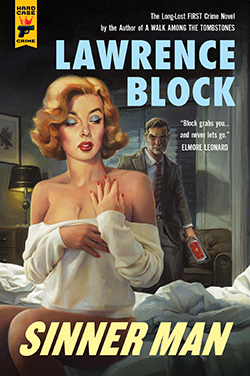 It's dark, violent noir and classic Hard Case Crime. I can't say I didn't see the end twist coming but it was still fantastic.
From Amazon:
From Amazon:
To escape punishment for a murder he didn't mean to commit, insurance man Don Barshter has to take on a new identity: Nathaniel Crowley, ferocious up-and-comer in the New York mob. But can he find safety in the skin of another man...a worse man...a sinner man...?Amazonians give it a 4.4. Goodreaders at 3.7 of 5. It's definitely one of the better books I've read in a while, tipping the scales at an 7+ on the 10-point Haugenometer.
Saturday, January 21, 2017
A top-fiver from Wes in 2016: Friday Night Lights
Friday Night Lights: A Town, a Team, and a Dream
by H.G. Bissinger
 As Sports Illustrated noted on the back cover: "The Best Football Book Ever"....I would agree. This was a masterpiece telling the story of "Friday Night Lights" in Odessa, Texas.
The book is about so much more than football: the town, the oil industry, the racial attitudes, the worship (at the time) of the Permian Panthers. Difficult to read in some chapters (centered around race), this is an important book to read. Glad I finally got around to reading it 20 years later! Reminded me some of my high school football experiences in some areas. 5 stars.
by H.G. Bissinger
The book is about so much more than football: the town, the oil industry, the racial attitudes, the worship (at the time) of the Permian Panthers. Difficult to read in some chapters (centered around race), this is an important book to read. Glad I finally got around to reading it 20 years later! Reminded me some of my high school football experiences in some areas. 5 stars.
Friday, January 20, 2017
A top-fiver from Wes in 2016: The Fractured Republic
The Fractured Republic: Renewing America’s Social Contract in the Age of Individualism
by Yuval Levin
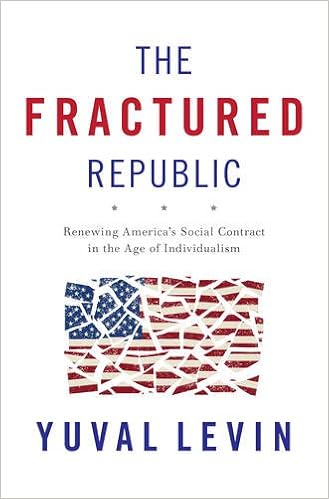 "Fractured Republic" is without a doubt, one of the best policy books I've read in years about America and why we have become so polarized as a country. Levin's core premise is that both Republicans and Democrats are striving to return to each party's "golden age" (1960s and 1980s specifically) where "things worked" in each party's view. Levin notes on p. 102: "Our politics of competing nostalgias often translation into a fight between individualism and statism that neglects the middle layers of society: the Right wants unmitigated economic individualism but a return to common moral norms. The Left wants unrestrained moral individualism but economic consolidation. Both will need to come to terms with some unconformable realities of twenty--first century America."
The author does a great job walking the reader through these decades and why things seem to have "fallen apart" in the 21st Century. Throughout the book I found myself highlighting key passages and ideas I haven't thought of or considered before or circling passages that effortlessly summarize my thoughts over the years following politics. This book helped me understand better at the 10000 foot view why our country seems "off the rails" and why both political parties are locked in such fierce battles and never-ending partisanship and brinkmanship.
Levin makes a lot of sense in this extended essay (as he calls it), which he as put considerable time and reflection into before putting pen to paper or started typing away. A treasure of a book and a road map to the future in our fractured, individualist era we are now living in. Levin states (p 104) that, "Too many Americans are detached from some core sources and channels of human flourishing--family, work, faith, and community. The challenges of governing are great. But they are made made even greater than they have to be by our inability to grasp our circumstances as their are." A must read before the 2016 election and beyond for serious people seeking serious solutions to today's problems.
by Yuval Levin
The author does a great job walking the reader through these decades and why things seem to have "fallen apart" in the 21st Century. Throughout the book I found myself highlighting key passages and ideas I haven't thought of or considered before or circling passages that effortlessly summarize my thoughts over the years following politics. This book helped me understand better at the 10000 foot view why our country seems "off the rails" and why both political parties are locked in such fierce battles and never-ending partisanship and brinkmanship.
Levin makes a lot of sense in this extended essay (as he calls it), which he as put considerable time and reflection into before putting pen to paper or started typing away. A treasure of a book and a road map to the future in our fractured, individualist era we are now living in. Levin states (p 104) that, "Too many Americans are detached from some core sources and channels of human flourishing--family, work, faith, and community. The challenges of governing are great. But they are made made even greater than they have to be by our inability to grasp our circumstances as their are." A must read before the 2016 election and beyond for serious people seeking serious solutions to today's problems.
Thursday, January 19, 2017
A top-fiver from Wes in 2016: Impossible People
Impossible People: Christian Courage and the Struggle for the Soul of Civilization
by Os Guinness
 As I look back at 2016, I believe "Impossible People" by Os Guinness is one of the most timely and important books I read. Guinness does a tremendous job and a terrific service to the reader, summarizing the peril that Western Civilization faces from enemies abroad and at home (and within our Church!)
Guinness notes: "At stake is the attempted completion of the centuries-long assault on the Jewish and Christian faiths and their replacement by progressive secularism as the defining faith of the West and the ideology said to be the best suited to the conditions of advanced modernity." (p.22)
He also states in a later chapter that "[The] future of the world in the next generations will be shaped decisively by the answer to three great questions:
1) Will Islam modernize peacefully in the end?
2) Which faith or ideology will replace Marxism in China?
3) Will the Western world sever or recover its roots? (The subject of this book)." p. 38
This book is a tour-de-force in a defense of Christianity and Judaism and Western Civilization. I found myself highlighting a passage on almost every page and notations in the margins throughout. His social commentary on the current world we live in is unsurpassed in modern writing. I would suggest reading the book slowly, grasping the big ideas and pondering and praying over his offered commentary.
In the end, Guinness challenges: "[Our] faith in God must always be our defining trust and the compass for our way of life. Living before the absolute presence of God, we are called to be faithful, and therefore unmanipulable, unbribable, undeterrable, and unclubbable [defines these terms in earlier chapters]. We serve an impossible God, and we are to be God's impossible people. Let us then determine and resolve to be so faithful in all the challenges and ordeals the onrushing future brings that it may be said of us that we in our turn have served God's purpose in our generation. So help us God". p.223
by Os Guinness
Guinness notes: "At stake is the attempted completion of the centuries-long assault on the Jewish and Christian faiths and their replacement by progressive secularism as the defining faith of the West and the ideology said to be the best suited to the conditions of advanced modernity." (p.22)
He also states in a later chapter that "[The] future of the world in the next generations will be shaped decisively by the answer to three great questions:
1) Will Islam modernize peacefully in the end?
2) Which faith or ideology will replace Marxism in China?
3) Will the Western world sever or recover its roots? (The subject of this book)." p. 38
This book is a tour-de-force in a defense of Christianity and Judaism and Western Civilization. I found myself highlighting a passage on almost every page and notations in the margins throughout. His social commentary on the current world we live in is unsurpassed in modern writing. I would suggest reading the book slowly, grasping the big ideas and pondering and praying over his offered commentary.
In the end, Guinness challenges: "[Our] faith in God must always be our defining trust and the compass for our way of life. Living before the absolute presence of God, we are called to be faithful, and therefore unmanipulable, unbribable, undeterrable, and unclubbable [defines these terms in earlier chapters]. We serve an impossible God, and we are to be God's impossible people. Let us then determine and resolve to be so faithful in all the challenges and ordeals the onrushing future brings that it may be said of us that we in our turn have served God's purpose in our generation. So help us God". p.223
Wednesday, January 18, 2017
A top-fiver from Wes in 2016: The River of Doubt
The River of Doubt: Theodore Roosevelt's Darkest Journey
by Candice Millard
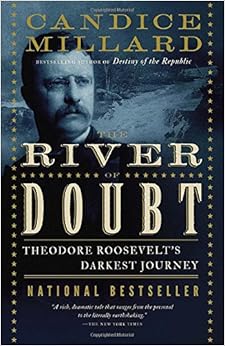 This spring my brother, father I had took a vacation or "mancation" to New York City. One of the highlights for me was to visit Theodore Roosevelt's Sagamore Hill home on Oyster Bay!
For the flight to NYC, I wanted to read an additional TR book to get my mind focused on the 26th president. Before I left, I picked up "The River of Doubt: Theodore Roosevelt's Darkest Journey" by Candice Millard about his expedition through the deepest parts of the Amazon rain forest and river. I was glad I did! Millard is a master of narrative non-fiction. This book is incredible. Millard did a great job introducing the characters in the book, and weaving them into the story. Millard has tremendous respect for nature and the Amazon and is able to convey the wonder of nature throughout this book. If you didn't know about this TR's expedition, you would think it was a novel. Its an unbelievable tale of grit, determination, hard work, leadership and survival in one of the last "unreached" people groups and areas of the globe at the time.
I would place this near the top of my favorite Theodore Roosevelt books and also history books in general. Bravo, Ms. Millard! 5 stars! Looking forward to more from her in the future hopefully!
by Candice Millard
For the flight to NYC, I wanted to read an additional TR book to get my mind focused on the 26th president. Before I left, I picked up "The River of Doubt: Theodore Roosevelt's Darkest Journey" by Candice Millard about his expedition through the deepest parts of the Amazon rain forest and river. I was glad I did! Millard is a master of narrative non-fiction. This book is incredible. Millard did a great job introducing the characters in the book, and weaving them into the story. Millard has tremendous respect for nature and the Amazon and is able to convey the wonder of nature throughout this book. If you didn't know about this TR's expedition, you would think it was a novel. Its an unbelievable tale of grit, determination, hard work, leadership and survival in one of the last "unreached" people groups and areas of the globe at the time.
I would place this near the top of my favorite Theodore Roosevelt books and also history books in general. Bravo, Ms. Millard! 5 stars! Looking forward to more from her in the future hopefully!
Tuesday, January 17, 2017
A top-fiver from Wes in 2016: Red Platoon
We’re not so far into 2017 that we still can’t look back at the best books we read last year. We’ve been busy! As such, I invited avid reader and co-worker Wes Roth to submit his best-of list. As you can see, he’s heavy into non-fiction, historical and political, but don’t hold that against him.
He has his top five, which I’ll feature one a day here. The one that didn’t make the list at No. 6 was Hillbilly Elegy, which was another fave among the 29 books he read last year.
So, in no particular order here is one of his top-fivers:

He has his top five, which I’ll feature one a day here. The one that didn’t make the list at No. 6 was Hillbilly Elegy, which was another fave among the 29 books he read last year.
So, in no particular order here is one of his top-fivers:
by Clint Romesha:
"In war, you play for keeps -- and because of that, there are no second chances and no do-overs. The calculus of combat, at its most brutal essence, is binary: you either overcome the hurdles that are flung in front of you and you figure out a way to make things happen, or you don't. Its a zero-sum, win-or-lose game with no middle ground--and no points for trying hard" (P. 324). This statement sums up war from former Staff Sgt Clint Romesha, who has written a military biography for the ages and one that should be read by every American.
Romesha was awarded numerous awards and decorations, including the Medal of Honor, for his bravery in on 10/3/09 at COP Keating. Widely reported at the time, and later covered by CNN's Jake Tapper on his show and in his book, "The Outpost," Romesha's "Red Platoon" gives the reader a heart-pounding account of the battle to protect COP Keating against an onslaught by the Taliban on that FalL day. Jaw-dropping, uncertain, hopeful, sad, heartbreaking were some of the emotions I experienced while reading this book. Its a vital contribution to this history in the war in Afghanistan and will be referenced for many years to come.
This was an excellent book and one of the best I've read recently. My heart breaks for the eight brave men that were lost and the families they left behind. We need to keep praying for them. A brief but important post written by veteran Ben Sledge should also be read after you read this book: "The Conversation About War and Our Veterans We Refuse to Have"
Saturday, January 14, 2017
So now I have to buy a book I wasn't going to
As you've seen by now, I'm not a fan of boycotts and bans. So I see something like this and it really burns me: A bunch of jealous children's book authors are protesting a book deal of Simon & Schuster with Milo Yiannopoulos. Basically, he's getting a $250k advance and they're not.

I don't know much about ol' Milo, except that he's gay, not liberal, and has said some controversial things. Oh, no! In this day and age of snowflakes and professional undies-in-a-bunchers, that's practically a felony.
Fine, the kids' lit authors are entitled to their opinion, but seriously? Authors wanting to curb free speech? And then they have the audacity to suggest they aren't suppressing free speech because Milo has other platforms (internet & organizations) to get his message out.
That's like saying it's okay to ban Huckleberry Finn in the libraries because people can read it online. What a bunch of crap from a bunch of crybabies who you'd think would know better.
I wonder if these kiddy book writers also protested other Simon & Schuster authors who have said or done controversial things: Hunter S. Thompson, Glenn Beck, Hillary Clinton, Mark Levin, Stephen King, Doris Kearns Goodwin, Donald Trump, Dick Cheney, Dan Brown, Carrie Fisher. Among others.
And the story mentions bookstores who plan to ban his book. As if they carry no books somebody else might find offensive. And they don't even know if there will be anything offensive in this book, only that they don't like the politics of its author. Good grief. Book sellers censoring. Craziness.
So many people disappointing me with their hypocrisy these days.
It's not just the hypocrisy of people who should be celebrating free speech actually thwarting it, but their stupidity in thinking boycotts work. All it does is bring more attention to Milo. Want to shut him up, ignore him.
I have a sticker on my portfolio at work that says "I buy banned books." I'd normally have no interest in Milo. Nothing against him, just no interest. But now I do. Now I'll buy his book, assuming our local bookstore sells it. If they don't, they'll be hearing from me.
As my wife and others who know me will attest, if you want me to do something, tell me I shouldn't.
The book is called Dangerous. It comes out March 14. Pre-order it here.
I don't know much about ol' Milo, except that he's gay, not liberal, and has said some controversial things. Oh, no! In this day and age of snowflakes and professional undies-in-a-bunchers, that's practically a felony.
Fine, the kids' lit authors are entitled to their opinion, but seriously? Authors wanting to curb free speech? And then they have the audacity to suggest they aren't suppressing free speech because Milo has other platforms (internet & organizations) to get his message out.
That's like saying it's okay to ban Huckleberry Finn in the libraries because people can read it online. What a bunch of crap from a bunch of crybabies who you'd think would know better.
I wonder if these kiddy book writers also protested other Simon & Schuster authors who have said or done controversial things: Hunter S. Thompson, Glenn Beck, Hillary Clinton, Mark Levin, Stephen King, Doris Kearns Goodwin, Donald Trump, Dick Cheney, Dan Brown, Carrie Fisher. Among others.
And the story mentions bookstores who plan to ban his book. As if they carry no books somebody else might find offensive. And they don't even know if there will be anything offensive in this book, only that they don't like the politics of its author. Good grief. Book sellers censoring. Craziness.
So many people disappointing me with their hypocrisy these days.
It's not just the hypocrisy of people who should be celebrating free speech actually thwarting it, but their stupidity in thinking boycotts work. All it does is bring more attention to Milo. Want to shut him up, ignore him.
I have a sticker on my portfolio at work that says "I buy banned books." I'd normally have no interest in Milo. Nothing against him, just no interest. But now I do. Now I'll buy his book, assuming our local bookstore sells it. If they don't, they'll be hearing from me.
As my wife and others who know me will attest, if you want me to do something, tell me I shouldn't.
The book is called Dangerous. It comes out March 14. Pre-order it here.
Subscribe to:
Posts (Atom)